Sacred Valley Altitude: How High Is Every Stop?
The Sacred Valley floor sits about 500 m below Cusco, but Pisac's ruins, Moray and Chinchero are as high or higher. Every stop in metres and feet, and the order to do them.
The floor of the Sacred Valley is lower than Cusco: Urubamba sits at about 2,870 m and Ollantaytambo at about 2,790 m, against 3,399 m in Cusco, so you sleep and eat roughly 500 to 600 m lower. That is the reason so many travellers go to the valley first and Cusco second. But the valley is not low everywhere. The ruins above Pisac average 3,400 m, Moray 3,480 m and Chinchero about 3,750 m, all as high as Cusco or higher. A Sacred Valley day climbs and drops several times, and it helps to know where.
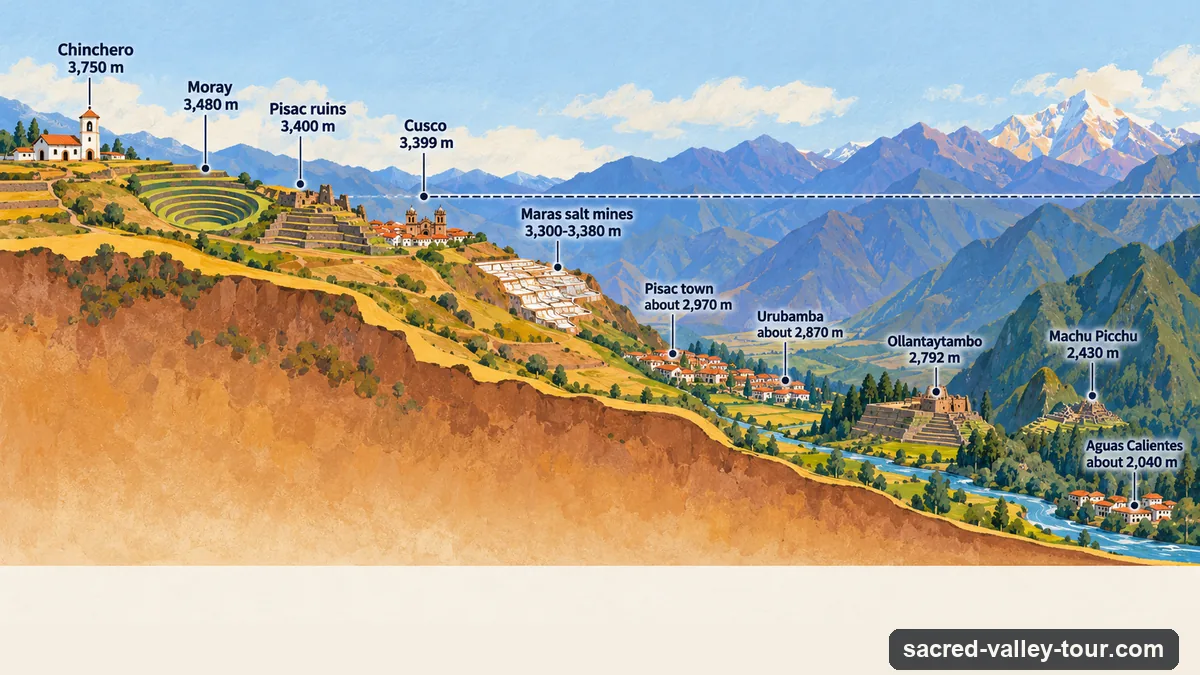
Every stop in metres and feet
| Place | Altitude | In feet | Compared with Cusco |
|---|---|---|---|
| Chinchero (archaeological park) | 3,750 m | 12,300 ft | about 350 m higher |
| Moray (circular terraces) | 3,480 m | 11,420 ft | about 80 m higher |
| Pisac ruins (archaeological park) | 3,400 m | 11,150 ft | the same |
| Cusco (city) | 3,399 m | 11,150 ft | |
| Maras salt mines | 3,300 to 3,380 m | 10,830 to 11,090 ft | slightly lower |
| Pisac town and market | about 2,970 m | 9,740 ft | about 430 m lower |
| Urubamba | about 2,870 m | 9,420 ft | about 530 m lower |
| Ollantaytambo (archaeological park) | 2,860 m | 9,380 ft | about 540 m lower |
| Ollantaytambo (town and station) | 2,792 m | 9,160 ft | about 610 m lower |
| Machu Picchu (citadel) | 2,430 m | 7,970 ft | about 970 m lower |
| Aguas Calientes (Machu Picchu Pueblo) | about 2,040 m | 6,690 ft | about 1,360 m lower |
Park averages from Peru’s Ministry of Culture (DDC Cusco); Cusco and Urubamba from INEI, the national statistics institute; Ollantaytambo station from Inca Rail; Machu Picchu from UNESCO; Pisac town and Aguas Calientes are the commonly published figures. Feet rounded to the nearest 10. Checked October 2026.
So, to answer the question people ask most: Machu Picchu is lower than both Cusco and most of the Sacred Valley’s ruins, and lower than the valley floor too. Only Aguas Calientes, the town below it, is lower again.
Valley first, then Cusco
If you fly into Cusco from sea level, the most common advice from travellers and tour operators is to go straight down to the valley for your first night or two, then come up to Cusco once your body has adjusted. The logic is simple: you sleep 500 m lower, and the tours you take from a valley base visit the high sites in daylight and bring you back down to sleep.
On a day tour from Cusco the profile is the other way round, but it is still kind on the body. You leave Cusco at about 3,400 m, drop to the valley floor at Pisac, spend the middle of the day around Urubamba and Ollantaytambo below 2,900 m, and come back over the Chinchero plateau at about 3,750 m in the late afternoon. The classic day is mostly lower than the city you started in, which is why it is often the first excursion people book after arriving.
The highest stops are short ones. At Chinchero you walk a few hundred metres of cobbled lanes and terraces; at Moray you look down into the circles from the rim. The steepest climb of the usual day is the Pisac ruins, where the terraces and paths climb hard above the car park, so take that one slowly.
Other Days Around Cusco
More Tours from Cusco and the Valley
Machu Picchu, Rainbow Mountain, the city and more: what else runs on your dates.
What altitude sickness feels like here
Above about 2,500 m many visitors feel the thin air: a headache, breathlessness on stairs, poor sleep, sometimes nausea. In the Sacred Valley it is usually mild because you spend so much time below 3,000 m, but the first day in Cusco can be tiring for anyone. What helps is ordinary and well known: go slowly for the first day or two, drink water, go easy on alcohol, and eat light. Coca tea is offered everywhere in the region and is part of the local welcome.
This page is not medical advice. If you have a heart or lung condition, are pregnant, or have had altitude sickness before, ask a doctor before you go. Symptoms that get worse rather than better, or confusion and breathlessness at rest, are a reason to go lower and get help.
Which day to put where
- Arriving from Lima or abroad? Spend your first night in Urubamba or Ollantaytambo if you can, or do the Sacred Valley day on your first full day in Cusco. The where-to-stay guide weighs the bases.
- Heading on to Machu Picchu? Tours that end in Ollantaytambo drop you at 2,792 m for the train down to Aguas Calientes at about 2,040 m: the lowest night of the trip.
- Doing Moray and the salt mines? The Moray and Maras half day stays up on the plateau at 3,300 to 3,750 m the whole time, so it is better after a day or two of acclimatisation than on day one.
- Saving Rainbow Mountain for later? It is far higher than anything in the valley. Leave it until the end of your stay.
How these facts were checked
Park altitudes and the road distances are from the Ministry of Culture’s Cusco office (culturacusco.gob.pe, park pages for Pisaq, Chinchero, Moray and Ollantaytambo). Cusco and Urubamba are from INEI. The Ollantaytambo station figure is from Inca Rail, Machu Picchu from UNESCO’s World Heritage listing, and the Maras range from the Ministry of Culture’s Qhapaq Nan programme. All read on 26 October 2026.
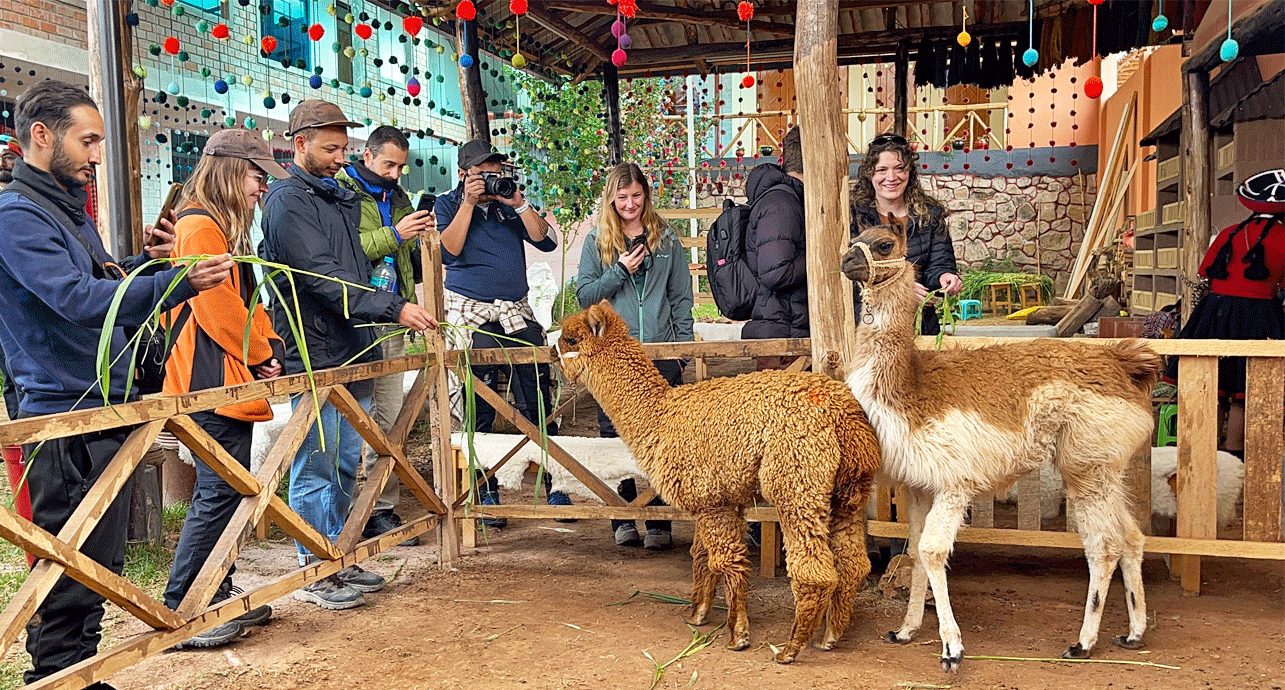
Start Low: the Sacred Valley Day from Cusco
The classic day spends its middle hours on the valley floor around Urubamba, at about 2,870 m, before the drive back over the Chinchero plateau. Buffet lunch included.
Check Dates for the Valley Day